

Introduction
Have you heard?! Clicker training cats is all the rage! Why? Because it is a fun and engaging activity that provides both physical and mental stimulation for your cat! Whether you want to teach your cat fun tricks, work on obedience skills, or train out unwanted behaviors, clicker training is for you.
Regardless of where you are in your cat training journey, you probably have questions. This guide will hopefully answer them all and help get you on the right path. If you have any additional questions, we recommend joining the Cat School Community where you have a direct line of communication with Julie Posluns, an applied animal behaviourist and cat trainer.
Table of Contents
Disclosure: Cat School may receive commissions from affiliate links included in this article.
Clicker Training Cats FAQs
What is clicker training?
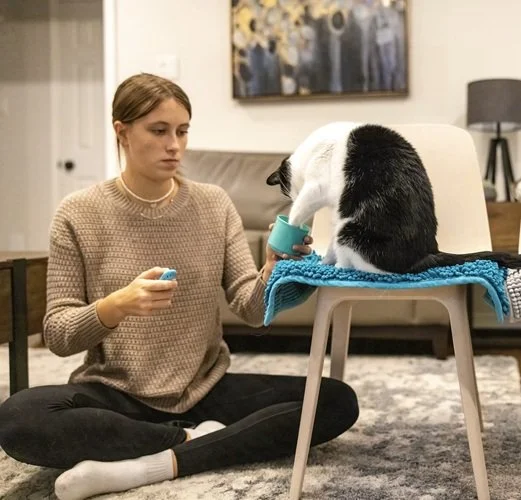
Clicker training is a form of positive reinforcement training. With clicker training, you mark your cat’s desirable behavior and then reward it. This training method gets its name because of the small, hand-held tool called a “clicker” that is used to mark your cat’s behaviors.
It is important to press the clicker at the exact moment your cat performs the desired behavior, and then follow up the click with a food reward. Your cat will quickly learn that the clicking sound equals a treat.
Further reading: How to Train a Cat: The Ultimate Cat Training Guide
Do I need a clicker?
You don’t necessarily need a clicker. If you don’t have access to one or are waiting for yours to arrive, you can instead make a clicking noise with your mouth or use the word “Yes” each time your cat performs the desired behavior.
For more precise behaviors like “high five,” a clicker is a useful tool because you want to capture that split-second action at the exact moment the behavior is demonstrated to let your cat know they did the skill correctly. For example, if you are teaching “high five” and your cat raises their paw, without the clicker, they won’t know what explicit behavior earned the reward.
What if my cat is scared of the sound of the clicker?
Your goal should be to help your cat overcome their fear of the clicker. Muffle the sound in a sock or click it from far away so it’s a lot quieter, then toss a treat to your cat. They will eventually start recognizing that the clicker means treats and no longer be afraid of it. Once your cat starts to recognize the clicker is a good thing, you can begin to fade out using the sock to muffle it.
What is a target stick?
In addition to a regular clicker, we also recommend using a target stick for clicker training cats. A target stick is a long, lightweight (and usually foldable or extendable) stick with a small ball on the end. It can easily fit inside your pocket when not extended.
Target sticks are popular items in both the pet and animal training world. They are a helpful tool to move your pet through space without physically forcing them. For our purposes, it’s a clear visual target to move a cat from one place to another.
The target stick we offer through Cat School is both a clicker and a target stick in one! It allows you to quickly mark the behavior without having to fumble for a separate clicker. It also has an extendable wand that allows you to change the length.
Further reading: What is a Target Stick and Why You Need One for Cat Training
What are the best treats for training?
There is no magical, universal training treat. Each cat will have different preferences, and different treats will work best for different situations. Understand that there are high-value and low-value treats so you can use them accordingly. Try to figure out what your cat’s absolute favorite treat is, and reserve that for training more difficult behaviors.
That special treat may be dry treats, kibble, wet food, freeze-dried, or squeezable treats. Each cat will have different preferences. It’s good to have multiple treats that your cat will work for.
Further reading: What are the Best Treats for Clicker Training Cats?
How long should a clicker training session last?
We recommend keeping your training sessions around 5 minutes long, especially in the beginning. If your cat is really into it, you can go for a bit longer, but you always want to end on a good note. If you push your cat too hard or for too long, they might lose interest or focus. You want to end your session before you lose your cat’s attention.
That being said, you can do multiple short training sessions in a day. Just be sure to give your cat a sufficient break in between.
Is my cat too old to be trained?
Never! Cats can be trained at any age – it’s never too late!
What age should I start training my cat?
You can start at any age. If you have a new kitten, you should focus more on socialization skills first – handling, being around other people, etc. These skills will set them up to be well-adjusted kitties, ready to begin clicker training!
Further reading: Is Training a Kitten Possible?
What if my cat isn’t food motivated?
If your cat isn’t willing to work for treats, it could be that you haven’t found the right tasty treat yet. Try some different treat options to find one that your cat deems worthy.
Your cat’s feeding schedule is also a big part of the training equation. If your cat has 24/7 access to a full food bowl, they won’t usually be very food motivated. Why work for a treat when they can just walk over to their food bowl whenever they want?
Feeding food with moisture and reserving any dry food for training only (i.e. not leaving a bowl of dry food out) is a good strategy. Adjusting your cat’s feeding schedule from free-feeding to planned, portioned meals high in moisture, while reserving all dry food and treats for training, will make a big difference in your cat’s willingness to work for treats!
Watch our video: Training A Picky Cat? Do This first!
What trick or behavior should I start with?
If you’re just starting out, it can be overwhelming trying to figure out where to start. We recommend starting with a new and easy behavior, such as target training or “sit.”
Knowing how and when to build on your skills can be tricky though, which is why we have a step-by-step training roadmap to follow in our online Cat School Course! It will guide you through the training process in a logical progression, eliminating any guesswork on your part as to where to start and where to go next.
My cat walks away or loses interest mid-session. What do I do?
When your cat walks away, they’re telling you something. Maybe the session was too long, the step you were working on was too hard, the treats you were trying to reward with weren’t valuable enough, your cat isn’t hungry, or there were too many distractions while you were training. You can try making your sessions shorter, making the step you are training slightly easier, using more desirable treats, training when your cat is most active or hungry, or trying again when there are fewer distractions.
You don’t need to chase after them and bring them back. Let them go and think through what you need to adjust for your next session.
Will my cat only perform when I have treats in my hand?
Not if you work on fading food lures and maintaining good training habits.
If you’ve trained a behavior using a food lure, you’ll need to fade having the food directly in your hand, and transition to a hand signal (empty hand making a similar gesture), still clicking and rewarding when your cat has performed the behavior.
Keeping treats out of sight by using a treat pouch or a nearby dish instead of holding the food in your hand can help. Only reach into the pouch or dish after you click. This way your cat is fully paying attention to when you click and not just looking at your treat hand.
Further reading: How Do I Train My Cat Without Treats?
Do I have to give my cat a treat every time they do a trick?
Once your cat gets comfortable and confident with a behavior or skill, you don’t necessarily have to give them a treat every time. However, you should still go back and revisit those mastered skills in your training sessions, giving your cat treats when they perform them. You don’t want to only ever be teaching new skills.
Another instance when you might not give your cat a treat after each skill is when you’re working on chaining skills together. For example, if you’re trying to train your cat to sit and then give a fist bump, you wouldn’t give them a treat after they perform sit. You’d give them the treat after they perform both behaviors back to back. You shouldn’t try chaining behaviors together though until your cat is 100% confident with each skill individually.
Should I still click if I’m not giving my cat a treat?
No. You want your cat to understand that a click means they get a treat. If you stop giving treats after clicking, then you will confuse them and cause training regression.
If you aren’t going to give your cat a treat after performing a behavior, you should not click.
What if I click at the wrong time?
If you click at the wrong moment, still give your cat a treat. The click is a promise that a reward is coming, and keeping that promise matters more than one mistimed click. A few mistakes won’t ruin all your training.
If you find yourself clicking late often, you can practice your timing and hand-eye coordination without your cat. Try clicking each time a ball hits the floor while a helper bounces it or click each time a certain character blinks while you’re watching TV.
When can I add a verbal cue?
Wait to add a cue until your cat is reliably offering the finished behavior. A good rule: you’d bet money they’ll do it on the next rep. If you add a cue too early in the learning process, your cat won’t connect the word with the behavior you want.
Will all these treats make my cat gain weight?
Not if you’re smart about it. Training rewards should be tiny, about the size of a lentil. Your cat cares about the taste, not how big each treat is.
The easiest way to avoid weight gain is to train with part of your cat’s daily food. Set aside a portion of their meals for training and feed a little less at mealtime to make up for it. Single-ingredient freeze-dried treats are also easy to break into small pieces. Save calorie-dense treats like lickables for the hardest training situations.
What if I have multiple cats?
You can train multiple cats at one time; however, it is a bit more difficult. If possible, you should start with one cat at a time. Training multiple cats simultaneously requires some prerequisite skills such as mat and/or chair training, as well as distractions such as food puzzles and/or snuffle mats.
We have a section in our online Cat School Course about training multiple cats if you’d like to learn more.
Can several family members train the same cat?
Absolutely! The key is consistency: everyone uses the same cues and hand signals and follows the same rules, like “if you click, you must treat.”
It can also help for one person to teach a new behavior first, then have others practice it once your cat knows it.
If multiple people are in the same room during training, only one person should train at a time, with the other people giving them some space so your cat isn’t getting confused with who they’re working with.
Can I use clicker training to stop unwanted behaviors, such as scratching and counter surfing?
Yes! We understand that not everyone is interested in teaching cute cat tricks. Some are more interested in eliminating bad behavior. The good news is that this is possible with clicker training.
To put it simply, there are 3 steps:
Identify why your cat is doing the behavior.
Try to prevent the behavior from happening so it does not get reinforced.
Once the behavior is managed, you can begin to train an alternative good behavior.
Further reading: How To Stop Your Cat’s Unwanted Behavior With Clicker Training
Can clicker training help a shy, fearful, or under-socialized cat?
Yes, it’s one of the best tools there is! Clicker training gives a nervous cat a predictable, low-pressure way to interact with people. The cat always gets to choose how close to come and how much to participate.
Start at whatever distance the cat is comfortable with. Click and reward small things: looking at you or just taking a step closer to you are rewardable behaviors. You can toss treats away from you after each click so the cat doesn’t need to take treats from your hand. It lets the cat retreat to a safe distance and then decide whether to come back. Over time, many shy cats will start to approach on their own. The target stick is also helpful, because this lets your cat interact with you without a hand coming toward them.
Go slowly and never force interaction.
Can you teach your cat to accept nail trims or teeth brushing using clicker training?
Absolutely! The key to nail trims and teeth brushing is to take things slowly and get your cat to not just tolerate the activity, but to willingly accept it. Of course, the earlier you start training these behaviors the better, but it is possible to get a cat of any age or temperament to accept nail trims and teeth brushing.
Further reading: A Step-by-Step Guide to Brushing A Cat’s Teeth
Can I train my cat to walk on a leash?
Contrary to popular belief, cats can be harness and leash trained! Going outside with your cat, even if it’s just in the backyard or front porch, is a great way to bond and let your cat experience the sights, smells, and sounds of the outdoor world in a safe and controlled way.
If you are interested in leash training your cat, we recommend the Kitty Holster harness. We also help walk you through harness training over in the Cat School Online Training Course!
As you can see, there is a lot to consider when clicker training cats, but once you get started, you won’t regret it! Both you and your cat will enjoy yourselves, and you’ll be on your way to building the bond between you and giving your cat a more enriched life.
If you have more training questions or need personalized help with your training, join the Cat School Community! Julie would love to meet you and your student and help you on your cat training journey!
Can I clicker train a deaf cat?
Yes! Instead of a click, you can use a visual marker. Common choices are a thumbs-up, a quick open-hand flash, or a blink from a small penlight (never shine it in your cat’s eyes). Teach the visual marker by flashing the penlight or your open hand/giving a thumbs-up, then giving a treat, repeating it until your cat looks like they have associated the two. You should see that the cat starts to look for/anticipate the treat when they see the flash, open hand, or thumbs-up.
Use hand signals for your cues. This approach also works well for senior cats with some hearing loss.
Want to join our community and learn more?
Check out our training programs at The Cat School and take the first step in unlocking your cat’s full potential!
